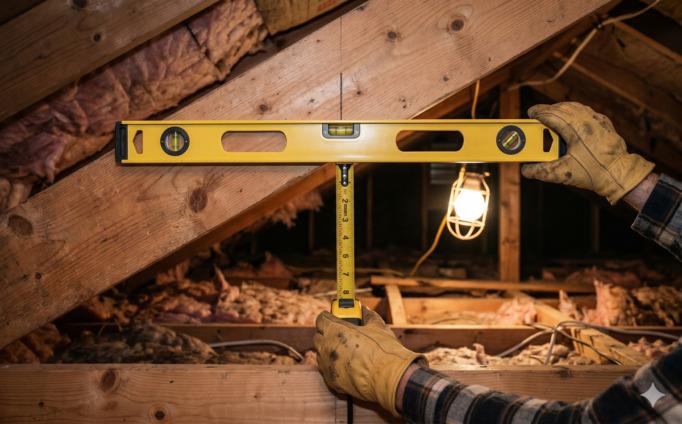
Measuring roof pitch is straightforward if you have the right tools and pick the safest of the four methods for your situation. The math is simple — rise over run — but accuracy depends on placing your measuring tools correctly and reading them honestly.
This guide walks through four field-tested methods: the level-and-tape method on the roof, the level-and-tape method from inside the attic, a digital angle finder or smartphone clinometer, and a speed square pivoted against a rafter. The attic method is the safest of the four for any pitch above 6/12, and the level-and-tape on the roof is the most accurate for shingled roofs in good condition.
Whether you are looking for how to figure out roof pitch on an existing house, how to determine pitch on a roof you are about to reroof, or how to tell the pitch of a roof you are inspecting before purchase, the technique is the same — what changes is which of the four methods is the right starting point. The sections below cover each in detail, then explain how to verify your reading, what to do with the number once you have it, and the common errors that produce wrong answers even when the method itself is sound.
What you will need
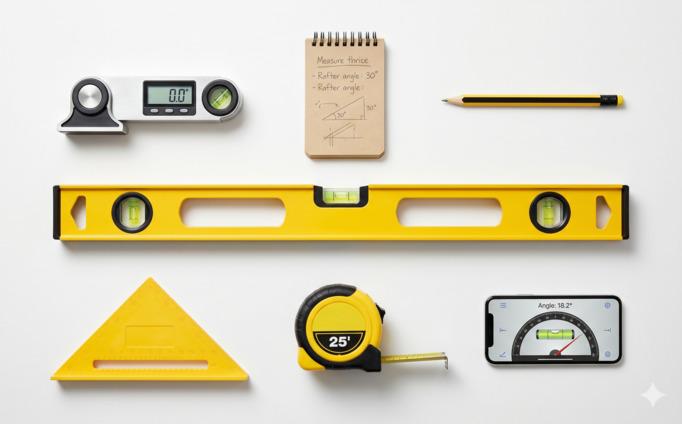
All three methods share a small set of basic tools. The right kit costs under $50 and pays for itself the first time you use it instead of guessing.
- A 2-foot spirit level. Bubble levels are perfectly accurate for pitch measurement; you do not need a digital level unless you want a degree readout directly.
- A standard tape measure, 25 feet or longer. A pocket-sized 12-foot tape works for the actual rise reading but a longer tape is useful for span measurement.
- A pencil and notepad. Write down each measurement immediately — do not rely on memory between three attempts.
- For roof-surface measurements: a stable extension ladder, non-slip footwear, and ideally a safety harness with a roof anchor.
- For digital methods: a digital angle finder ($20–60) or a smartphone with a built-in or installed clinometer app.
Method 1 — Level and tape, on the roof
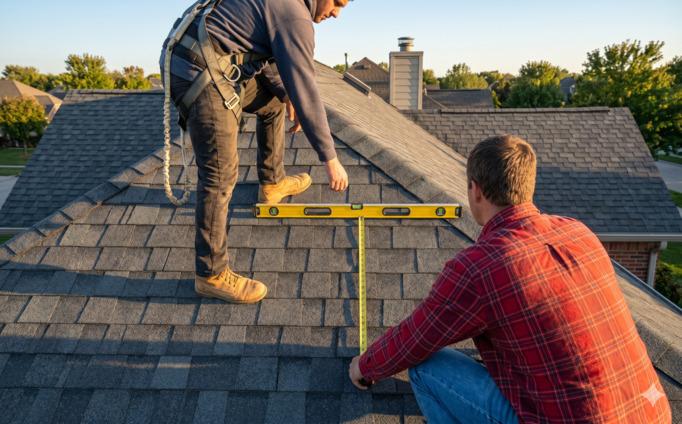
This is the classic field method and gives you the most direct reading on a shingled roof in good condition. You need to be on the roof, so the safety bar is high — anything steeper than 6/12 is best measured from the attic instead.
Set up your ladder securely against the eave. Climb to the roof and find a stable spot to stand or kneel, away from the eave edge. Place the spirit level horizontally against the roof surface, with one end pointing uphill toward the ridge. Lift the uphill end until the bubble reads level. Do not let the level rest on the shingles below it — it should be touching at the down-roof end only.
With the level held bubble-level, mark the 12-inch point on the roof surface directly below the level. Then measure vertically from that 12-inch mark up to the underside of the level. That vertical distance, in inches, is your rise. The run is exactly 12. So if the vertical is 5 inches, your pitch is 5/12.
Repeat in two other locations along the roof and average the results. If two readings agree and one is way off, the outlier is probably a warped shingle or a soft spot in the sheathing — discard it and measure again.
Method 2 — Level and tape, from inside the attic
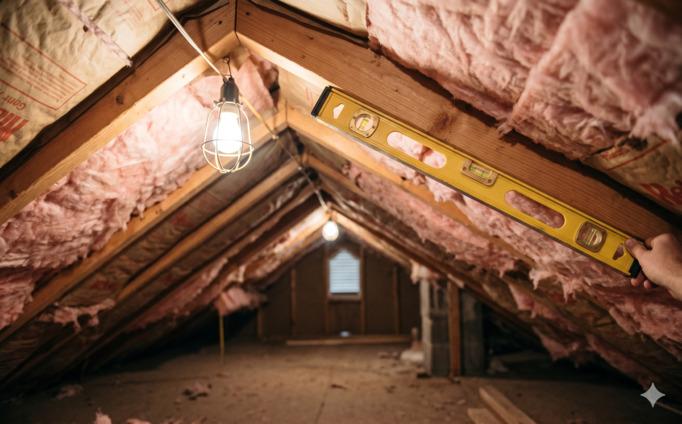
The attic method is the safest and one of the most accurate techniques. It reads pitch directly off the framing rather than the roof surface, so shingle thickness and roof-surface irregularities do not affect the result.
Bring your level, tape, pencil, and a flashlight into the attic. Pick a clean rafter — one without obvious bowing or damage. Place the spirit level horizontally with one end touching the underside of the rafter, somewhere along its length (not at the very top or bottom). Push the free end up until the bubble reads level. The level should be hanging in space, touching the rafter at one point only.
With the level bubbled, mark the 12-inch point on the level itself (or use a marked pre-cut stick). From that 12-inch mark, measure straight up to the bottom edge of the rafter. That vertical distance is your rise.
This works best with the level oriented along the rafter's direction (i.e., perpendicular to the wall plate). If your rafters are encased in finished material, you can still measure — pop out a small inspection hole or use the gable-end framing where the rafters are usually exposed.
Method 3 — Digital angle finder or smartphone
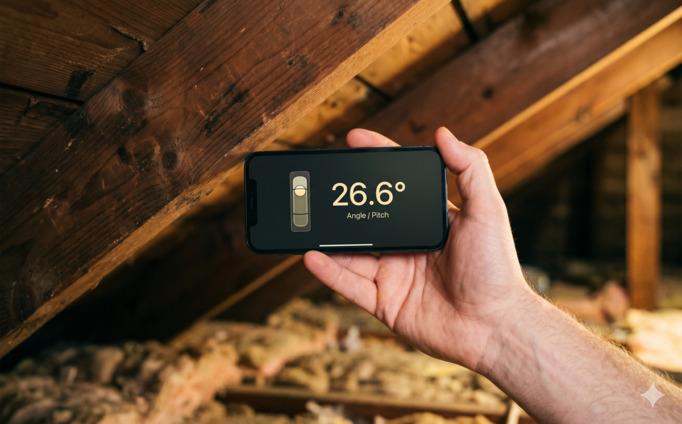
Digital angle finders give you a degree reading in seconds with no math. Place the device flat against a rafter (in the attic) or directly on the roof surface, press the zero button on a known-level reference first if needed, then take the reading. A typical digital angle finder reads to 0.1° accuracy.
Smartphones with iOS Measure or Android equivalents can do the same job — lay the phone flat against a rafter or a roof surface and read the angle. Accuracy depends on the phone's accelerometer calibration; some phones drift after a year or two and benefit from re-calibrating before each use.
The calculator on this site has a mobile sensor mode that uses your phone's built-in tilt sensor to capture the angle. It works best on Android (where motion permissions are automatic) and on iOS 13+ (where the browser will ask you to grant permission once). Once you have a degree reading, switch to the calculator's "Angle → Pitch" tab and the conversion is instant.
Method 4 — Speed square against a rafter
A speed square (also called a rafter square or Swanson square) is the framer's shortcut for reading pitch. The triangular tool has degree markings printed along its hypotenuse plus a "common" rafter scale that reads pitch directly as rise per 12. If you have a speed square and access to an exposed rafter, you can read pitch in about ten seconds — no level, no tape, no math. This roof pitch speed square technique is the answer to "how to find roof pitch with speed square" and the simplest method for anyone framing or inspecting from inside.
The technique: hold the speed square so its long flat edge sits flush against the underside of a rafter (or against the rafter's top edge if you're working from above the deck). Pivot the square until its short flat edge — the one with the pivot mark — points straight down toward the floor or a plumb line you have dropped. The number on the "common" scale where it crosses the rafter's edge is your pitch as rise per 12. The same intersection on the "degrees" scale gives you the angle directly. The level vial built into many speed squares makes the "point straight down" step easier — when the bubble is centered, the square is plumb and the reading is true.
When this method shines: rough framing inspections during walkthroughs, working in tight spaces where a 2-foot level cannot fit, quick pitch checks from inside an unfinished attic, and any situation where you need an answer in seconds rather than minutes. When it falls short: the pitch markings on a speed square typically run from 1 to 12 in whole numbers, so half-pitches and very steep readings (above 12/12) need one of the other methods. Speed squares also wear over time — verify the markings against a known pitch before relying on a worn or marked-up tool for a code-sensitive measurement.
Comparing the four methods — accuracy, safety, speed, cost
Each of the four methods has a place. The right choice depends on roof access, the pitch class you are reading, the precision you need, and the tools you happen to have. The block below compares all four side-by-side so you can pick the best fit for your situation in one look.
How to verify your measurement
Whichever method you use, take three measurements and average them. Random error in a single reading can be as much as 1° in any direction — three readings averaged out get you within about 0.3° of true.
Round your final answer to the nearest standard pitch. The standard pitches are 1/12, 2/12, 3/12, all the way up to 24/12 in whole-number increments. If your average reads 4.2/12, your roof is a 4/12. If it reads 4.6/12, your roof is closer to 5/12. Standard pitches are what your shingle and underlayment specifications assume — being half a pitch off the standard matters; being a fraction of a degree off the standard does not.
What to do with your pitch measurement
Once you have a verified pitch — whether from the level-and-tape, the angle finder, or the speed square — the number is the input to half a dozen practical decisions. The measurement itself is the easy part; using it correctly is what matters.
Convert to all the formats you might need. The pitch ratio is what you talk in with shingle suppliers and framers. The angle in degrees is what architects, engineers, and code officials use. The slope percent is what civil engineers and drainage specs reference. The slope factor (the multiplier from footprint to actual roof surface area) is what you use to order material. Plug your measurement into the calculator on the home page and you will get all four outputs at once, plus the canonical reference for every standard pitch.
Use the slope factor to order the right amount of material. A 4/12 roof has a slope factor of 1.054, so a 1,000 sq ft footprint covers 1,054 sq ft of actual roof. A 12/12 roof has a slope factor of 1.414, so the same footprint covers 1,414 sq ft. Over-ordering wastes money on returns; under-ordering means a delayed install. Get this number right by reading the canonical reference table on the common pitches reference rather than estimating.
Check code compliance against your measurement. The IRC R905.1.1 threshold for asphalt shingles is 2/12 — below that you need a true low-slope membrane. The single-layer-underlayment threshold is 4/12 — between 2/12 and 4/12 you need double-layer. If your measured pitch lands near one of these thresholds, the difference between 3.8/12 and 4.1/12 changes your underlayment spec and your warranty terms. Always round before you order, never after.
For framing decisions, use the pitch to compute rafter length. The math is built into the rafter length calculator on this site — plug in your pitch and your span, and you get common rafter length, plumb cut angle, and seat cut angle. For specific pitches we cover in detail, see the dedicated guides for 4/12, 6/12, 8/12, and 12/12.
Common measurement errors and how to avoid them
Five errors account for almost every wrong pitch reading. Each one has a specific fix that takes seconds.
- Reading the shingled roof surface instead of the underlying deck. Architectural shingles add roughly 1/2 inch of thickness; that compresses the apparent pitch reading by up to 1° on a level laid on the surface. Fix: measure from inside the attic against the rafter underside (Method 2) where shingle thickness is invisible to the measurement.
- Single-spot measurement on a bowed rafter. Old rafters bow over decades; a single reading at the bowed midpoint reads low, and a reading near the ridge or eave reads steep. Fix: take three readings at three locations along the rafter and average them, exactly as you would on a roof surface.
- Speed square against a weathered or worn rafter edge. Rough-sawn lumber and decades-old framing can have rafter edges that are not crisp enough for a speed square to register an accurate pitch. Fix: use Method 1 or 2 with a fresh 2-foot level on a clean reference surface, or scrape a small flat reference patch on the rafter before placing the square.
- Confusing degree readout with pitch ratio when ordering. Ordering shingles for an 18° roof when you mean a 4/12 pitch is fine — those describe the same roof. Ordering shingles for "an 18-pitch roof" when you mean 18° is a disaster — there is no 18/12 in the standard residential band. Fix: when reading from a digital angle finder or smartphone, always convert to pitch ratio before talking to a supplier.
- Not accounting for sag in the middle of long-span rafters. On spans above about 24 feet without intermediate support, the rafters can sag 1/4 to 1/2 inch at the midpoint; measuring there reads steeper than the design pitch. Fix: measure within the first 4 feet of the eave or the last 4 feet before the ridge, or use the gable-end framing where rafters meet the wall.
Need to run the numbers?Use the free roof pitch calculator on the home page to convert pitch to angle, calculate rafter length, or estimate roof area in any unit.