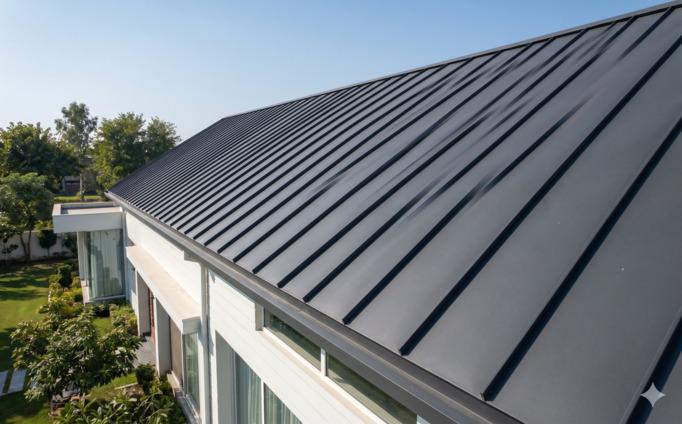
A metal roof quote rolls together six variables: roof surface area, panel type and gauge, complexity factors (hips, valleys, dormers, penetrations), tear-off requirements, accessories, and regional labour rates. National averages for installed standing-seam metal in 2026 are running between $10 and $16 per square foot, with through-fastened corrugated coming in at $7 to $12 per square foot. The spread on a typical 2,000 sq ft roof is therefore $14,000 to $32,000 — a 2× swing that depends almost entirely on which configuration you spec.
This guide walks through every line item you should expect to see on a quote, what reasonable numbers look like, and which costs you have leverage to shrink. It is intended for homeowners getting bids, not for roofers writing them.
Roof Replacement Cost Calculator
Installed cost range by material, region, roof complexity, and tear-off needs.
Inputs
Most jurisdictions allow only 2 layers; some areas require strip-down.
Results
Total installed cost range
Low
$7,513
Typical
$10,644
High
$13,774
Anatomy of a metal roof quote
A reputable metal roofing quote breaks the price into discrete line items rather than presenting a single bottom-line number. The transparency matters because it lets you compare bids on a per-line basis, identify hidden upcharges, and negotiate the items where you have leverage. A sealed bid for "$18,500 for a metal roof, all-in" tells you nothing about whether you are paying market rates or 30% above them.
The standard line items are: tear-off and disposal, underlayment, panels (with gauge and finish specified), trim package, fasteners or clips, ridge ventilation, eave details, valley flashing, penetration flashings, snow retention (in snow regions), labour, permitting, and warranty registration. Some quotes also separate dump fees, equipment rental for steep-pitched access, and engineering letters for high-wind or seismic regions.
Panel type and gauge — the biggest cost driver
The single largest cost variable is the panel system. Through-fastened corrugated metal — the simplest and most familiar metal roof — runs $2.50 to $4.50 per square foot for material alone. The fastener heads are visible on the roof surface and the panels are screwed directly through to the deck or framing. It is the cheapest metal option but has the shortest service life because the fastener gaskets degrade in 20-25 years and the panels themselves expand and contract against fixed screws.
Standing-seam metal — the higher-tier residential option — runs $4 to $8 per square foot for material alone. Panels lock together at raised vertical seams and are attached with hidden clips that allow thermal expansion. The result is a 50+ year service life with no exposed fasteners. Within standing-seam, the differentiators are profile (snap-lock versus mechanical-lock), seam height (1 inch versus 1.5 inches versus 2+ inches for severe environments), and finish.
Gauge measures panel thickness — lower gauge numbers mean thicker panels. 29-gauge is the cheapest metal roofing and is borderline for residential use; 26-gauge is the cost-effective standard for through-fastened panels; 24-gauge is the standard for residential standing-seam; 22-gauge is heavy-duty for commercial or severe-weather use. Each step down in gauge adds roughly $0.50 to $1.00 per square foot to the material cost but materially extends service life.
| Panel system | Material / sq ft | Service life | Best for |
|---|---|---|---|
| Through-fastened corrugated (29-gauge) | $2.00 - $3.00 | 15-20 years | Agricultural, sheds, budget farm-style residential |
| Through-fastened corrugated (26-gauge) | $2.50 - $4.50 | 20-25 years | Residential mainstream through-fastened |
| Snap-lock standing-seam (24-gauge) | $4.00 - $6.50 | 40-50 years | Most cost-effective standing-seam for residential |
| Mechanical-lock standing-seam (24-gauge) | $5.50 - $8.00 | 50-60 years | Premium residential and severe-weather; can run lower pitches |
| Heavy-duty standing-seam (22-gauge, 1.5"+ seam) | $7.00 - $10.00 | 60+ years | High-wind coastal, severe snow, commercial |
Finish — the hidden longevity variable
The metal panel itself is usually steel or aluminium; the finish is what determines how the roof looks in 30 years. The finish hierarchy from cheapest to longest-lived: polyester paint, silicone-modified polyester (SMP), polyvinylidene fluoride (PVDF, sold under brand names like Kynar 500 or Hylar 5000).
Polyester paint fades and chalks within 10-15 years and is found mainly on agricultural or budget panels. SMP paints last 20-30 years and have moderate fade resistance, common on mid-range residential metal. PVDF (Kynar) is the gold standard for residential metal — 40+ year fade resistance, full-strength colour retention through three generations of weather. The PVDF premium is roughly $0.50 to $1.50 per square foot over SMP. On a 2,000 sq ft roof that is $1,000 to $3,000 — a small fraction of total project cost for a finish that lasts twice as long.
Galvalume (zinc-aluminium-coated steel) and Galvanized (zinc-coated steel) refer to the substrate underneath the finish, not the visible top coat. Galvalume is more corrosion-resistant in coastal and humid environments and is the substrate spec to insist on for any climate east of the Mississippi or within 50 miles of a coast.
| Finish | Fade resistance | Price premium vs polyester | Best for |
|---|---|---|---|
| Polyester paint | 10-15 years | Baseline | Agricultural buildings, budget panels |
| Silicone-modified polyester (SMP) | 20-30 years | +$0.30 - $0.70 / sq ft | Mid-range residential; moderate climate |
| PVDF (Kynar 500 / Hylar 5000) | 40+ years | +$0.80 - $2.00 / sq ft | Premium residential; chalk-resistant; full colour retention |
| Galvalume substrate (under finish) | N/A | +$0.20 - $0.40 / sq ft | Coastal, humid, or eastern U.S. climates — corrosion resistance |
Roof complexity — what makes a quote double
Complexity factors push a metal roof quote up faster than the bare panel cost. A simple gable on a single-story rectangle is the baseline. Adding hip roofs adds 10-15% to labour because every hip rafter is a long compound cut. Adding dormers, the geometric and labour cost climbs sharply: a roof with three dormers can cost 25-40% more than the same area without them, because each dormer creates four new flashing details, two new valleys, and significant panel cutting waste.
Steep pitches add labour cost above 8/12 (the conventional walkable threshold). Above 12/12, expect a 15-25% labour premium because crews work in harnesses and material handling slows down. Above 18/12 a "hard rope" or scaffolding rental is typically required, adding fixed equipment costs of $500-2,000 for the project.
Penetrations matter more on metal than on shingles. Each plumbing vent, chimney, skylight, and HVAC penetration needs a custom-formed flashing boot or a custom-fabricated pan flashing. Metal roofers price these at $50-150 per penetration for standard pipes and $300-1,000 for chimneys and skylights.
Tear-off, decking inspection, and underlayment
Tear-off is the demolition of the existing roof. Metal-over-metal recovers (installing new metal over an old metal roof) are sometimes possible but usually not advisable; metal-over-shingle recovers are allowed in many jurisdictions and save $1.50 to $3.00 per square foot in tear-off and disposal cost. The trade-off is lower service life because the underlying shingles still degrade and the trapped layers can hold moisture.
A proper tear-off includes inspecting the roof deck for rot or damaged sheathing. Quotes typically include a base allowance for replacing 1-3 sheets; anything beyond that is an add-on at $80-150 per sheet installed. If the contractor finds extensive deck damage during tear-off, you should expect a written change order specifying exact sheet count and unit price before they proceed.
Underlayment for metal roofs has gotten substantially better in the past decade. The current standard is a synthetic high-temperature underlayment rated for 240°F+ continuous exposure (metal panels can reach 180°F in summer sun). Cheap felt underlayment will degrade under that heat and will need to be replaced before the metal does. Spec a synthetic underlayment by name (Sharkskin, GAF Tiger Paw HT, Owens Corning ProArmor HT) — the cost difference is $0.10-0.20 per square foot.
Red flags in a metal roof quote
A quote without specified gauge, finish, and substrate is incomplete. "26-gauge metal panels with paint finish" allows the contractor to install the cheapest available panel and still satisfy the quote. Insist on specs like "24-gauge Galvalume substrate, PVDF finish, 1.75-inch standing seam, mechanically-locked".
A quote that excludes underlayment specifications, ventilation details, ice-and-water shield in valleys and at eaves, or trim metal gauge is a quote you will pay change orders on. Cheap underlayment, mismatched trim metal, or inadequate ventilation will each shorten the service life of the assembly by 5-20 years.
A quote that promises "lifetime warranty" without specifying coverage terms is misleading. Real warranties have explicit terms for paint fade, substrate failure, and labour. The strongest paint warranties (PVDF) typically cover 30-40 years against chalking and fading; substrate warranties (Galvalume) typically cover 25-30 years against perforation. Labour warranties are usually 5-10 years.
Questions to ask every contractor
Before signing a metal roofing contract, ask the contractor: how many metal roofs they have installed in the past two years, what panel manufacturer they use most often, whether they are a certified installer for that manufacturer, and whether the manufacturer warranty requires certified installation to remain valid. Ask to see photos of installations they have done that are at least 5 years old.
Verify the contractor carries general liability insurance covering at least $1 million, workers compensation insurance covering all crew, and a current state-specific contractor license. Verify with the issuing state, not just the document the contractor gives you. Ask for three local customer references whose roofs are at least three years old, and call them.
How we sourced these quote-evaluation criteria
Quote evaluation criteria reflect industry-standard residential roofing contractor practice and verification standards. Insurance and licensing thresholds reflect IRC and major-state contractor licensing requirements. Manufacturer warranty terms reflect verified policies from major metal roofing producers (Englert, McElroy, Drexel Metals, Fabral). Recommendations are reviewed annually and updated when industry data changes.
For metal-roof-specific cost references that pair with this quote-evaluation guide, this site has dedicated tools. The metal roof pricing per square reference covers per-square pricing by panel type and gauge. The roofing materials prices guide covers metal alongside other material options.
For broader project-cost references when comparing metal roofing against other options, related pages cover the surrounding decision. The roof replacement cost reference covers full-project pricing. The roof quote guide covers what a quality bid should include for any roof type. The cost of roof repair page covers minor repair budgets that can extend an existing roof's life vs. full replacement.
For DIY-leaning homeowners exploring metal-roof labour-saving strategies, the diy roof replacement cost reference covers what self-management saves and what it costs in time. The cheapest way to replace a roof reference covers cost-saving strategies that work across material types.
Need to run the numbers?Use the free roof pitch calculator on the home page to convert pitch to angle, calculate rafter length, or estimate roof area in any unit.