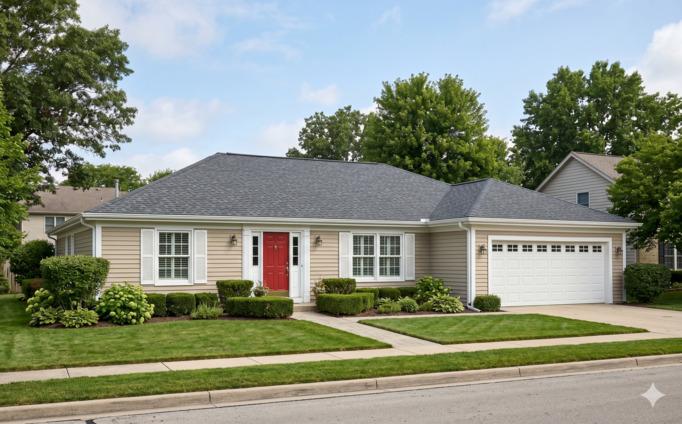
A 4/12 roof pitch rises 4 inches vertically for every 12 inches of horizontal run. That converts to 18.43° from horizontal, a slope of 33.3%, and a slope factor of 1.054 (meaning the roof surface is 5.4% larger than the building footprint underneath it). It is the single most common pitch in U.S. residential construction — the default specified in roughly 30-40% of new homes built since 2000, and the threshold pitch above which all standard roofing materials are usable without special detailing.
This guide covers why 4/12 is the workhorse, the math behind it, what materials work at this pitch (most do), the practical implications for cost and walkability, the framing details (rafter cuts, common truss dimensions, and bird's-mouth depth), where 4/12 fits and where it doesn't, and how it compares to its neighbours at 3/12, 5/12, and 6/12.
4/12 in degrees, slope percent, and slope factor
A 4/12 roof pitch is exactly 18.43° from horizontal. That is the answer most readers are looking for when they search "4/12 pitch in degrees" — it is the fixed result of the trigonometric identity arctan(4 ÷ 12) × (180 ÷ π), and it is the same regardless of building size, span, or roof shape. Every 4/12 roof has the same angle.
The slope as a percentage is 33.33%, computed as (4 ÷ 12) × 100. The slope factor — also called the pitch multiplier or roof multiplier — is 1.054, computed as √(4² + 12²) ÷ 12 = √160 ÷ 12. Multiply your building's footprint area by 1.054 to get the actual roof surface area you will need to cover. A 1,500 sq ft footprint becomes 1,581 sq ft of roof surface on a simple 4/12 gable.
When someone asks "what does 4/12 pitch mean?" — they are asking about all four numbers together: the rise-over-run ratio (4/12), the angle (18.43°), the slope percent (33.3%), and the slope factor (1.054). Builders and shingle suppliers usually talk in the ratio. Architects, engineers, and code officials usually talk in degrees. Civil engineers and drainage specs use slope percent. The slope factor is the working number for ordering material. All four describe the same physical roof.
4/12 by the numbers
A 4/12 pitch is exactly 18.43° from horizontal. The slope as a percentage is 33.33% (4 ÷ 12 × 100). The slope factor — the multiplier that converts building footprint to actual roof surface area — is 1.054. For a 1,500 sq ft footprint house, the roof surface area on a simple 4/12 gable is 1,581 sq ft. Order shingles, sheathing, and underlayment against that surface number, not the footprint.
Rafter math at 4/12: for every 12 inches of horizontal run, the rafter length itself is √(4² + 12²) ≈ 12.65 inches. For a 14-foot run (the half-span of a 28-foot building), the common rafter length to ridge is roughly 14 × 12.65 / 12 = 14.76 feet, plus any overhang and ridge offset.
Putting 4/12 in context with its neighbours at 3/12, 5/12, and 6/12 helps you see why 4/12 sits where it does in the residential band. The numbers below come from the canonical pitch-to-degree conversions and are exact.
Why 4/12 is the U.S. residential default
Three things made 4/12 the default. First: it sits at the boundary between low-slope and conventional-slope, which means it qualifies for the full range of asphalt shingle products and standard manufacturer warranties. Anything below 4/12 requires double underlayment per IRC R905.1.1; 4/12 does not.
Second: it produces a usable but not extravagant attic volume. A 30-foot wide gable at 4/12 has an attic peak height of 5 feet, enough for storage and ventilation but not so much as to add framing cost. Steeper pitches add significant attic volume but also add material, labour, and insurance liability for "useable" space the homeowner did not pay to finish.
Third: it is comfortably walkable. Roofers can move freely without fall-arrest harnesses, which keeps labour rates at the regional baseline. Above 8/12, labour costs step up 20-50%; at 4/12 you pay the cheapest residential labour rates available.
Together those three factors mean 4/12 is the lowest-cost pitch that does not impose material restrictions or warranty complications. Production builders default to 4/12 unless an architectural style or engineering requirement specifies otherwise.
Materials that work at 4/12
Asphalt three-tab shingles: install with single-layer underlayment per manufacturer specs. Standard 25-year warranty terms apply. Roughly $8,000-13,000 installed on a typical 2,000 sq ft house.
Asphalt architectural shingles: same single-layer underlayment, 30-50 year warranty. The U.S. residential default. Roughly $11,000-18,000 installed.
Standing-seam metal panels: comfortable above 3/12 and ideal at 4/12. The relatively shallow pitch keeps panel-buckling and oil-canning concerns manageable. Roughly $20,000-34,000 installed.
Through-fastened corrugated metal: works at 4/12 but minimum-pitch sheets need extended overlap and sealant detail. Roughly $14,000-22,000 installed.
Concrete tile and clay tile: 4/12 is the typical minimum for tile (some manufacturers require 4.5/12 or higher). Underlayment specs are stricter than for asphalt. Roughly $20,000-44,000 installed depending on tile type.
Natural slate: 4/12 is the absolute minimum for slate; 6/12 and above is preferred. Below 4/12, slate is inappropriate. Roughly $30,000-60,000+ installed.
Wood shake: 4/12 is the standard minimum for wood shake. Below this, water shedding is inadequate for the gap-and-overlap design. Roughly $20,000-30,000 installed.
| Material | Minimum pitch | Underlayment at 4/12 | Warranty range | Installed cost |
|---|---|---|---|---|
| Asphalt three-tab shingles | 2/12 (with double underlayment) | Single layer | 20-25 years | $8,000 - $13,000 |
| Asphalt architectural shingles | 2/12 (with double underlayment) | Single layer | 30-50 years | $11,000 - $18,000 |
| Standing-seam metal | 1/4:12 - 3/12 | Synthetic, full deck | 40-60+ years | $20,000 - $34,000 |
| Through-fastened corrugated metal | 3/12 | Synthetic, full deck | 25-40 years | $14,000 - $22,000 |
| Concrete tile | 4/12 (some 4.5/12) | Heavy-duty + battens | 50+ years | $20,000 - $34,000 |
| Clay tile | 4/12 | Heavy-duty + battens | 75-100 years | $30,000 - $44,000 |
| Natural slate | 4/12 (6/12 preferred) | Synthetic + ice + water | 75-200 years | $30,000 - $60,000+ |
| Wood shake / cedar | 4/12 | Felt + interlayment | 30-50 years | $20,000 - $30,000 |
Framing a 4/12 roof — rafters, trusses, and cuts
The framing math at 4/12 is friendly. The pitch produces clean numbers, the cuts fall within standard speed-square ranges, and the rafter geometry works for either stick framing or trusses without unusual detailing.
Rafter length: for every 12 inches of horizontal run, the common rafter spans 12.65 inches along the slope (the hypotenuse of a 4-12 right triangle). For a 24-foot building (12-foot run), the common rafter length is 12 × 12.65 / 12 = 12.65 feet, plus any tail overhang. For a 30-foot building (15-foot run), the rafter is 15.81 feet. For a 40-foot building (20-foot run), the rafter is 21.08 feet. Add the overhang projection, run it through the slope-factor (1.054) for the actual length, and you have your stock cut length before plumb and seat cuts.
Plumb cut and seat cut: the plumb cut at the ridge end of a 4/12 rafter is 18.43° from the rafter line — exactly equal to the roof angle. The seat cut at the wall plate is 71.57° (90° minus the roof angle). Set your speed square at the 4-inch mark on the common-rafter scale and the cut lines fall in place. The bird's-mouth depth is conventionally one-third of the rafter depth, leaving two-thirds of the rafter resting on the wall plate.
Truss dimensions for typical 4/12 spans: a 24-foot span produces an overall truss height of 4 feet at the centre; a 30-foot span yields 5 feet; a 40-foot span yields 6.67 feet. These dimensions are useful when planning ceiling heights, room volumes for finished attics, or storage clearance. The exact truss design (king post, queen post, or attic truss) depends on span and live-load requirements, and any non-prescriptive condition should be reviewed by a structural engineer or truss-plant designer before fabrication. For project-specific rafter geometry, plug your numbers into the dedicated rafter length calculator.
Where 4/12 works (and where it doesn't)
A 4/12 pitch performs well across most of the contiguous U.S., but climate and architectural style both push the decision in or out of this band. Where 4/12 is the right answer, it is unambiguously the right answer; where it is wrong, the failure mode is usually expensive and slow to surface.
Where 4/12 fits comfortably: dry and mild climates (Sun Belt, Pacific Coast, much of the South), hurricane-resistant new construction (the lower wind-uplift profile of a 4/12 outperforms steeper roofs in named-storm regions when properly detailed), modular and manufactured housing (factory specs are written for 4/12), and any architectural style in the Ranch / Mid-Century / Modern / Contemporary family. The horizontal massing of these styles is what 4/12 is for.
Where 4/12 is marginal: heavy-snow regions (the Snow Belt, interior Northeast, Rocky Mountain states). At 4/12, snow accumulates rather than sheds — roofs need engineered snow guards, ice-and-water shield well past the eaves, and substantially heavier framing for the live load. Many heavy-snow jurisdictions require 6/12 or steeper for residential. A 4/12 in Vermont is not impossible, but it is solving a problem with insulation and structure that a 6/12 solves with geometry.
Where 4/12 is wrong: any architectural style defined by a steep roof. A 4/12 Tudor reads as wrong from the curb, and so does a 4/12 Victorian, Cape Cod, or A-frame. The pitch is part of the silhouette in these styles; reducing it to 4/12 produces a building that looks unsure of itself. If you are matching a defined style, follow the typical pitch range from the architectural style index on the common pitches reference. If you are doing a generic build with no specific style commitment, 4/12 is rarely a wrong call.
Common mistakes when working with a 4/12 pitch
Four mistakes show up repeatedly on 4/12 projects, each with a different cost profile.
- Confusing 4/12 with the IRC asphalt-shingle minimum. IRC R905.1.1 sets the asphalt-shingle minimum at 2/12 with double-layer underlayment; 4/12 is the threshold above which single-layer underlayment is allowed. Some builders mistakenly cite 4/12 as the absolute minimum and refuse to spec lower, when 2/12 to 4/12 is actually code-compliant with the right underlayment. The reverse mistake — installing single-layer underlayment at 3/12 because "4/12 is similar" — voids the warranty.
- Assuming "4/12" rounds from 3.5/12 or 4.5/12 freely. The threshold is precise. A measured pitch of 3.5/12 is low-slope and needs double underlayment with asphalt; a measured pitch of 4.5/12 is conventional and gets single-layer. Round before you order or you will misorder underlayment.
- Specifying slate or wood shake at exactly 4/12. Both materials list 4/12 as their minimum, but minimum is not preferred. At 4/12, slate and shake have shorter service lives, more frequent maintenance issues, and tighter installation tolerances than at 6/12 or above. If the budget says slate or shake, push the pitch to 6/12 — the extra cost on framing is a fraction of the cost of premature failure.
- Underestimating snow load in cold-climate 4/12 designs. A 4/12 roof in a 50-pound-snow-load region (typical for the Northeast and Mountain West) carries roughly twice the live load of the same roof in a 20-pound region. The framing must be engineered for the local load, not assumed from a default. This is one of the most common reasons cold-climate 4/12 roofs need retrofitting after the first severe winter.
How 4/12 compares to 3/12 and 6/12
Compared to 3/12 (a low-slope pitch), 4/12 is the threshold above which standard residential roofing materials and warranty terms apply. A 3/12 roof requires double underlayment under asphalt shingles, has more limited material options, and looks visually shallow. A 4/12 roof has full material flexibility, standard underlayment, and reads as a normal residential profile.
Compared to 6/12 (a moderately steeper conventional pitch), 4/12 is cheaper but offers less attic space. A 6/12 roof on the same 30-foot building has 7.5 feet of peak height versus 5 feet at 4/12 — a meaningful difference for usable storage or future finished-attic conversions. Material costs at 6/12 run 5-8% higher than 4/12 due to the slightly larger surface area; labour costs are similar because 6/12 is still solidly walkable.
For new construction where you are choosing the pitch: 4/12 is the value choice, 6/12 adds usable attic volume for modest cost premium, 8/12 and above belong to specific architectural styles or finished-attic designs.
Cost in 2026
For a typical 2,000 sq ft single-story house with simple gable roof at 4/12 pitch in average U.S. markets: architectural asphalt shingle replacement runs $11,000-18,000 installed in 2026. Three-tab is $8,000-13,000. Standing-seam metal is $20,000-34,000.
The pitch itself has a small effect on cost at this end of the scale. Compared to 6/12, 4/12 saves 1-3% on material (smaller surface area) and is essentially the same labour cost. Compared to 8/12, 4/12 saves 3-5% on material and 5-10% on labour. Compared to 12/12, 4/12 saves 10-15% on material and 20-30% on labour.
Use the calculator on the home page or the roof replacement cost calculator to dial in a project-specific estimate.
Common 4/12 applications
Production tract homes — most builders default to 4/12 for the cost and warranty reasons above.
Mid-century modern and ranch architectural styles — the shallow pitch is a defining stylistic element.
Garages, additions, and accessory buildings where a low-profile roof matches existing structures.
Modular and manufactured homes — 4/12 is the most common factory-spec pitch.
Commercial-residential transitions — small office buildings and mixed-use structures often use 4/12.
Need to run the numbers?Use the free roof pitch calculator on the home page to convert pitch to angle, calculate rafter length, or estimate roof area in any unit.