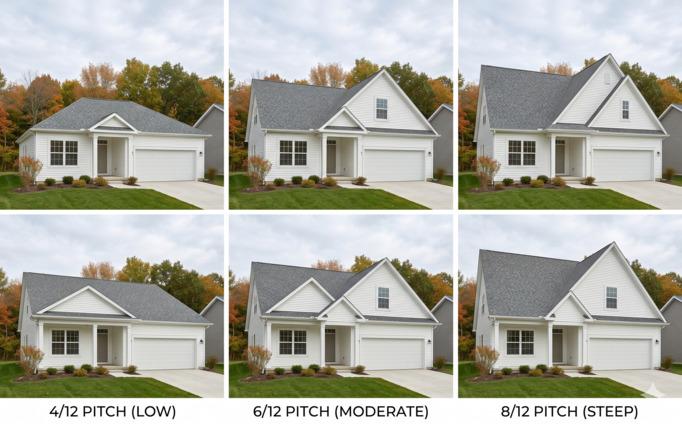
Roof pitches in U.S. residential construction tend to cluster around a handful of standard ratios — 4/12, 6/12, 8/12 — because each one balances drainage, attic space, framing cost, and material compatibility differently. The most common roof pitch in U.S. residential construction is 4/12 to 6/12 — the residential sweet spot for most regions outside heavy snow country. This guide walks through every common roof pitch you are likely to encounter, from the nearly flat 1/12 to the dramatic 24/12 spire, with the angle, slope factor, classification, and typical applications for each.
Use it as a reference when sizing a new build, evaluating an existing roof, or simply trying to understand what someone meant by "a 7/12 pitch". The interactive table below lets you click any pitch to load it directly into the main calculator. Below the table you will find sections covering what counts as a "standard" roof pitch, how pitch maps to architectural style, what is normal in different climate regions, and the common mistakes homeowners make when choosing one.
| Classification | Common use | Calculate | ||||
|---|---|---|---|---|---|---|
| 1/12 | 4.76° | 8.3% | 1.003 | Flat | Very low slope; membrane only | Use 1/12 → |
| 2/12 | 9.46° | 16.7% | 1.014 | Low slope | Minimum for asphalt shingles (with double underlayment) | Use 2/12 → |
| 3/12 | 14.04° | 25% | 1.031 | Low slope | Low slope; sheds, garages, additions | Use 3/12 → |
| 4/12 | 18.43° | 33.3% | 1.054 | Conventional | Most common residential pitch | Use 4/12 → |
| 5/12 | 22.62° | 41.7% | 1.083 | Conventional | Mid-range residential, more attic | Use 5/12 → |
| 6/12 | 26.57° | 50% | 1.118 | Conventional | Walkable, generous attic space | Use 6/12 → |
| 7/12 | 30.26° | 58.3% | 1.158 | Conventional | Architectural emphasis | Use 7/12 → |
| 8/12 | 33.69° | 66.7% | 1.202 | Steep slope | Borderline walkable; steep-slope category | Use 8/12 → |
| 9/12 | 36.87° | 75% | 1.25 | Steep slope | Cape Cod / traditional | Use 9/12 → |
| 10/12 | 39.81° | 83.3% | 1.302 | Steep slope | Storybook / cottage | Use 10/12 → |
| 11/12 | 42.51° | 91.7% | 1.357 | Steep slope | Steep traditional | Use 11/12 → |
| 12/12 | 45° | 100% | 1.414 | Steep slope | Gable cottages, A-frames (45°) | Use 12/12 → |
| 14/12 | 49.4° | 116.7% | 1.537 | Steep slope | Tower / decorative steep | Use 14/12 → |
| 16/12 | 53.13° | 133.3% | 1.667 | Steep slope | Victorian, churches | Use 16/12 → |
| 18/12 | 56.31° | 150% | 1.803 | Steep slope | Steeple-like | Use 18/12 → |
| 20/12 | 59.04° | 166.7% | 1.944 | Steep slope | Spire-adjacent | Use 20/12 → |
| 24/12 | 63.43° | 200% | 2.236 | Steep slope | Tower / spire (very steep) | Use 24/12 → |
What "standard" actually means in roof pitch
A standard roof pitch in U.S. residential construction is any pitch in the conventional band — roughly 4/12 to 8/12 — that the building industry treats as the default for ordinary new homes. There is no formal regulation that defines "standard" the way IRC R905 defines "minimum"; the term is industry usage. When a contractor, lumber yard, or framer says "standard pitch", they almost always mean something in the 4/12 to 6/12 range.
A normal or typical roof pitch on a U.S. home — phrased the same way as standard, just in casual conversation — refers to the same band. The typical home roof pitch on new American houses built in the past two decades is 4/12, with 6/12 a close second. Together those two ratios account for the majority of residential construction. A traditional roof pitch — used to describe historic styles or homes built before mid-century — is typically steeper, in the 7/12 to 12/12 range, because pre-mass-production framing favoured taller roofs for ventilation, attic storage, and drainage in regions without modern membranes.
So when you read "average roof slope" or "good roof pitch" or "roof pitch guidelines" in different sources, they are all describing variations on the same idea: pitch the local building culture has settled on as the path of least resistance. Understanding roof pitch comparison across these terms — common, normal, typical, standard, traditional — is mostly a matter of recognising they describe the same idea from slightly different angles. The exact band varies a little by region, climate, decade, and architectural style — which is what the rest of this guide breaks down into different roof pitches and the types of roof pitches you are likely to encounter.
Low-slope roofs (1/12 to 3/12)
Low-slope roofs sit at the boundary between flat-roof technology and steep-slope shingle systems. They look nearly horizontal from the ground, which gives modern homes a clean architectural line and makes commercial buildings easy and cheap to frame. The trade-off is drainage: water moves slowly across a low-slope deck and any imperfection in the membrane shows up as a leak.
A 1/12 pitch is functionally a flat roof. You will need a true low-slope membrane — modified bitumen, EPDM, TPO, or PVC — and meticulous drainage detailing. A 2/12 pitch is the absolute minimum for asphalt shingles per IRC R905.1.1, but only with double-layer underlayment or a self-adhered ice-and-water shield across the entire deck. A 3/12 pitch is the sweet spot for sheds, garages, and many additions: shallow enough to feel modest, steep enough that asphalt shingles work well with reasonable underlayment.
Low-slope roofs are easy to walk and inspect, which makes ongoing maintenance practical. Plan on cleaning debris twice a year and checking seams annually. The flatter the roof, the more frequent the inspection schedule should be.
Real-world examples: contemporary modern homes (1/12 to 3/12), most flat-roof commercial buildings (1/12 to 2/12), detached garages and storage sheds (3/12 standard), and many post-war ranches in the Sun Belt (3/12 to 4/12 to keep cooling loads down).
Conventional pitches (4/12 to 7/12) — the standard band
This is the dominant pitch range across U.S. residential construction. Roughly 70% of new homes built in the past two decades fall somewhere between 4/12 and 7/12 because the band balances every constraint reasonably well: water drains quickly, snow slides off without piling, attic space is workable, framing is efficient, and almost every roofing material is approved.
A 4/12 pitch (18.43°) is the workhorse — the most common pitch for ranches, contemporary homes, and modest additions. It is walkable, allows single-layer underlayment with asphalt shingles, and reads visually as low-key. A 6/12 (26.57°) is the next step up: still walkable with care, generous attic volume, and a more pronounced architectural presence. A 7/12 (30.26°) starts to feel intentionally steep — Cape Cod and traditional New England homes often live in this range.
Within this band the choice is mostly aesthetic and about how much attic you want. Material costs do not change much. Labour cost goes up slightly with each pitch class because steeper roofs take longer to walk and require more careful staging.
Real-world examples: most ranch and split-level homes (4/12), suburban two-storey colonials (5/12 to 6/12), Cape Cod and bungalow styles (6/12 to 7/12), the great majority of new tract-built homes from 1950 onward. If you point at a random U.S. house, statistically the pitch will fall here.
Steep-slope roofs (8/12 and above)
Steep roofs are visually dominant by design. Victorian, Tudor, Gothic Revival, and many farmhouse styles depend on aggressive pitch as a defining feature. They also offer the most generous attic volume — at 12/12, a 30-foot-wide house has a 15-foot-tall attic at the ridge, easily enough for a finished living space.
The cost goes up substantially. Above 8/12 most contractors require fall protection, which slows the install. Above 12/12 you are looking at scaffolding, longer rafter cuts, and higher material waste from the steeper angles. Repair access becomes a real expense over the roof's life because every visit requires harnessing in.
Steep roofs are exceptional water and snow shedders. In heavy snow regions they reduce structural load substantially because snow slides off rather than accumulating. Combined with proper ice-and-water shield at the eaves and adequate attic ventilation, a steep roof in a cold climate can outlast a conventional roof by decades.
Real-world examples: Victorian and Queen Anne homes (10/12 to 14/12), Tudor revival (10/12 to 12/12), traditional farmhouses with attic living spaces (10/12), Gothic Revival churches (16/12+), A-frame cabins and ski chalets (16/12 to 24/12). Pre-1900 city houses in the Northeast routinely run 10/12 or steeper.
Pitch by architectural style — the lookup index
Different residential styles have settled on different "standard" pitches, and matching the pitch to the style is one of the strongest signals that a house was designed with intention rather than thrown together. If you are renovating, restoring, or building new in a defined style, this index gets you to the right starting range.
| Style | Typical pitch range | Why this range |
|---|---|---|
| Ranch / rambler | 3/12 to 5/12 | Horizontal proportions are the defining feature; steeper fights the architecture |
| Mid-century modern | 1/12 to 4/12 | Low pitch is intentional; some MCM homes are nearly flat with deep overhangs |
| Contemporary | 1/12 to 6/12 | Mixed pitches and shed sections are signature; flat-and-shed is part of the look |
| Cape Cod | 8/12 to 12/12 | Steep front gable is the recognizable feature; lower pitches read as imitations |
| Bungalow / Craftsman | 4/12 to 6/12 | Low pitch with deep eaves and exposed rafter tails is the Craftsman signature |
| Colonial / Saltbox | 6/12 to 12/12 (front), 4/12 to 6/12 (rear on saltboxes) | Steeper than ranch, less than Tudor; saltbox asymmetry is intentional |
| Tudor revival | 10/12 to 14/12 | Aggressive steep gables and asymmetric massing; lower pitch loses the look |
| Victorian / Queen Anne | 12/12 to 16/12 | Often combined with turrets and dormers that compound perceived steepness |
| Farmhouse (traditional) | 9/12 to 12/12 | Tall enough for an attic story; the iconic American farmhouse silhouette |
| Modern farmhouse | 6/12 to 9/12 | 2010s reinterpretation softens traditional steepness for easier framing |
| A-frame / chalet | 16/12 to 24/12 | The roof IS the structure; pitch often equals or exceeds wall pitch |
| Gambrel / Dutch Colonial | 24/12 lower, 4/12 upper | Two-piece roof; break-line creates the characteristic barn silhouette |
| Mansard / French Second Empire | 24/12+ lower, near-flat top | Two-piece; near-vertical lower section maximises attic-as-living-space |
Pitch by U.S. climate region
Climate quietly drives a lot of regional pitch convention. Builders in different parts of the country have settled on ranges that work for their local snow load, rainfall, and wind exposure — and the ranges have stayed remarkably consistent over decades because the underlying physics has not changed.
Snow Belt and Northeast (interior New England, Upstate NY, Great Lakes, northern Mountain West): 6/12 to 12/12 is normal. Steeper sheds snow faster, reducing structural load on the framing. The traditional Cape Cod and Colonial steep-gable forms developed precisely for this reason. New builds that try to use 4/12 in heavy-snow zones often need engineered snow guards or commercial-grade ice-and-water protection.
Pacific Northwest: 4/12 to 8/12. Heavy rainfall but minimal snow — pitch is for drainage rather than load. Moss and algae are the bigger concerns; pitches in the 6/12 range shed both better than flatter alternatives.
Mountain West and Rockies: 6/12 to 14/12. Deep snow and wind drift demand steeper roofs; modern energy codes also reward steeper pitches that accommodate thick attic insulation.
Sun Belt and Southwest (Arizona, New Mexico, southern California, Florida, Gulf Coast): 3/12 to 6/12. Minimal snow, often no significant rain — the ranch and stucco-Mediterranean traditions favour low pitch. Hurricane regions add wind-uplift detailing to whatever pitch the architecture calls for.
Plains and Midwest: 4/12 to 8/12. The middle ground — moderate snow, moderate rain, all pitches viable. Most tract-built suburbs default to 5/12 or 6/12.
| Region | Typical pitch | Climate driver | Notes |
|---|---|---|---|
| Snow Belt / Northeast (interior NE, Upstate NY, Great Lakes) | 6/12 to 12/12 | Heavy snow load, ice damming risk | Cape Cod and Colonial steep-gable traditions developed here |
| Mountain West / Rockies | 6/12 to 14/12 | Deep snow + wind drift | Modern energy codes favour steep pitch for attic insulation thickness |
| Pacific Northwest | 4/12 to 8/12 | Heavy rain, minimal snow | Moss and algae management drives pitch toward 6/12 |
| Plains / Midwest | 4/12 to 8/12 | Moderate everything | Most tract-built suburbs default to 5/12 or 6/12 |
| Sun Belt / Southwest (TX, AZ, NM, southern CA) | 3/12 to 6/12 | Minimal snow, hot sun | Ranch + stucco-Mediterranean traditions favour low pitch |
| Gulf Coast / Florida | 3/12 to 6/12 | Heavy rain, hurricane wind | Pitch follows architecture; wind-uplift detailing is the priority |
Pitch by roof shape
The shape of the roof — gable, hip, shed, gambrel, mansard, hip-and-valley — interacts with pitch in ways that change the typical range for each form.
- Gable (the classic A-shape with two sloped planes): 3/12 to 12/12 covers nearly all examples. Most flexible roof shape and accepts the widest range of pitches. The default residential form.
- Hip (four sloped planes meeting at a ridge or peak): 4/12 to 9/12 most common. Hip roofs have shorter rafters than gables of the same span, so they accommodate a moderate pitch comfortably. Better wind performance than gables in hurricane zones.
- Shed (single sloped plane): 1/12 to 4/12 most common. The shed form lives in low-slope territory because steep shed roofs become wall-like. Common on additions, modern homes, and outbuildings.
- Gambrel (Dutch Colonial / barn roof — two slopes per side): nearly always two-piece, with a steep lower section (usually 22/12 to 24/12) and a shallower upper section (typically 4/12 to 6/12). The break-line creates the characteristic barn silhouette.
- Mansard (French Second Empire — four-sided gambrel variant): also two-piece; near-vertical lower (sometimes 30/12 or steeper) and nearly flat top deck. Maximises attic-as-living-space.
- Hip-and-valley / cross-gable (intersecting roofs over complex floor plans): each section follows the rules above, but the intersections require attention. Mixing widely different pitches in one roof creates valleys that are hard to flash and clean.
Recognising pitch from the ground
Most builders develop a feel for pitch within a year of working on roofs, but the rough visual cues are easy to learn. A 4/12 pitch reads as quiet and modest — you almost do not notice the roof line. A 6/12 starts to feel like a deliberate slope — visible from the curb but not dramatic. An 8/12 becomes a feature of the house — you see the roof before the walls. A 12/12 pitch reads as a 45° angle, half horizontal and half vertical, and is unmistakable. Anything steeper than 12/12 starts to feel architectural rather than functional.
A useful trick: hold up your hand at arm's length, palm flat, fingers extended. The angle from your wrist to your fingertips is roughly 45°, which is a 12/12 pitch. Most residential roofs you see are visibly less steep than that.
How to pick a pitch for a new build
For a new build or a major addition, work backwards from your constraints. Climate first: snow regions push toward 6/12 or steeper, mild dry climates have the most freedom. Material next: if you have your heart set on slate or wood shake, you need 4/12 minimum. Attic goals next: if you want a finished attic, you need 10/12 or steeper. Aesthetic and neighbourhood last: match the dominant style of nearby houses unless you are deliberately making a statement.
When in doubt, default to 6/12. It is the most forgiving pitch in the conventional band — works with everything, looks neutral, structurally efficient, and gives you a workable attic. It is the safest bet for a generic residential build.
Common mistakes when choosing a roof pitch
Most pitch decisions go wrong in one of five predictable ways. Each one shows up on the bill or on the maintenance schedule, often years after the original install.
- Choosing a pitch below your material's minimum to save framing cost. A 3/12 with standard architectural shingles "works" — until the warranty expires faster than the homeowner expected, leaks at the eaves in year 6, or fails wind-uplift testing during the next inspection. The fix is choosing the material that matches the pitch, not the other way around.
- Mismatching pitch to the architectural style. A 4/12 Tudor and a 12/12 ranch both read as "wrong" to anyone who knows the styles, and resale appraisers quietly mark the home down for it. If the style is defined, match the pitch range to the style.
- Forgetting climate. A 4/12 roof in Burlington, Vermont, will hold snow loads that a 4/12 in Austin, Texas, will never see. The same pitch is a different engineering problem in different climates. Heavy-snow regions almost always benefit from 6/12 or steeper; insurance discounts often follow.
- Underestimating future maintenance access. A 10/12 roof gets a fall-protection markup on every roofer visit for the rest of its life — typically $200–$400 per visit. Over twenty years, the steep-pitch decision quietly costs $4,000+ in inspection and minor-repair surcharges.
- Treating attic space as free. A steeper pitch creates more attic, but conditioning, finishing, and insulating that attic is a large project. Building a 10/12 just to "have the option" of finishing the attic later, without committing to the project, can mean paying for volume you never use.
Need to run the numbers?Use the free roof pitch calculator on the home page to convert pitch to angle, calculate rafter length, or estimate roof area in any unit.