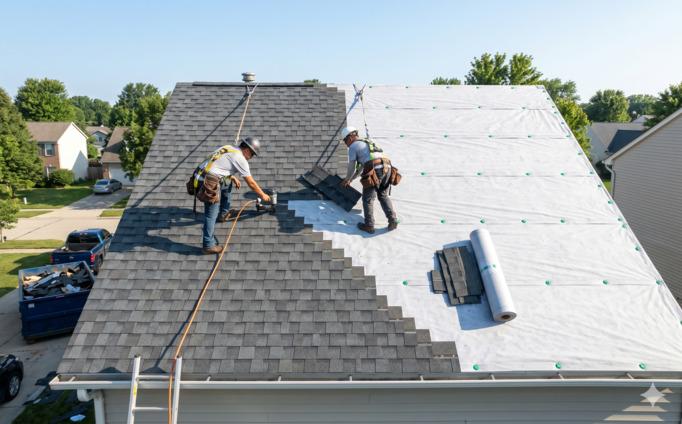
A roof replacement is one of the larger investments most homeowners make in their property — and one of the few that gets done only once or twice in a typical home's life. The process strips the existing roof down to the deck, repairs damaged sheathing, installs new underlayment and flashing, and lays new finish material. Done well, the result lasts 25-50 years depending on material. Done poorly, you are looking at premature failure, voided warranties, and interior water damage that costs more to repair than the original project.
A complete roof replacement (sometimes called a full roof replacement, a total roof replacement, or simply a new roof installation) is a 2-4 day project on a typical residential home. The terms describe slightly different scopes — re-roofing a house with a clean tear-off down to the deck is the standard interpretation; new roof construction on a brand-new building skips the tear-off step but is otherwise the same install. New residential roof projects, whether on existing homes or new builds, follow the same six-step sequence covered in this guide.
Different homeowners use different phrases for the same project. New roof replacement, roof replacement roofing, roof replacement house, new roof roofing, new house roof, re-roofing a house, redo roof, roof replacement roof installation — all describe the same 2-4 day project to strip the existing roof and install a new one. New roof tiles specifically refers to tile-roof replacement (concrete or clay), which follows the same install sequence but uses different fasteners and underlayment specifications. New roof for home is generic phrasing for the same project. Whatever the search phrase, this guide answers the same underlying question: what does it actually take to put a new roof on a house?
This guide walks through every stage of a typical roof replacement: deciding when you need a new roof, the actual scope of work in a roof replacement installation, timeline, cost ranges by material in 2026, how to choose a contractor, what your insurance does and doesn't cover, and the questions that separate a successful project from a regrettable one.
Roof Replacement Cost Calculator
Installed cost range by material, region, roof complexity, and tear-off needs.
Inputs
Most jurisdictions allow only 2 layers; some areas require strip-down.
Results
Total installed cost range
Low
$7,513
Typical
$10,644
High
$13,774
When to replace versus repair
Three signals push a roof from "repair territory" into "replace territory". First: age. Asphalt shingle roofs typically last 18-25 years. If yours is past 18 years and you are seeing repair calls, replacement is usually the right answer because the underlying shingle mat is brittle and the next problem is just a matter of time. Metal roofs last 40-60+ years; tile and slate roofs last 50-100+ years. The age threshold is material-specific.
Second: cumulative repair cost. If you are spending more than 30% of replacement cost in a 12-month period on repairs, you are subsidizing a failing roof. Replace it.
Third: visible end-of-life signs. Granules in the gutter heavier than the previous year. Curled, lifted, or missing shingles across multiple slopes. Daylight visible through the deck from the attic. Water staining on rafters. Sagging anywhere along the ridge or eaves. Any one of these in isolation might be a repair; multiple at once means replacement.
A roof in good visible condition that is only 12-15 years old almost always belongs in repair territory. A roof at 22+ years with growing problems almost always belongs in replacement territory. The genuinely difficult judgement zone is 16-21 years on asphalt — and that is where talking to two or three local roofers, asking specifically what they would do if the roof were theirs, gives you the most useful information.
What a roof replacement actually includes
A complete asphalt shingle replacement on a typical residential roof includes the following work, in order. Tear-off of all existing roofing material and underlayment down to the deck. Disposal of all debris. Inspection of the deck for rot, water damage, structural issues, or undersized sheathing. Replacement of damaged sheathing — base contracts typically include 1-3 sheets; additional damage is billed per sheet. Installation of ice-and-water shield at eaves (the bottom 24-36 inches) and in valleys. Installation of drip edge along eaves and rakes. Installation of synthetic underlayment over the entire deck.
Then the finish work: installation of starter shingles along eaves and rakes, installation of field shingles in courses, installation of step flashing where the roof meets walls or chimneys, installation of pipe boots at plumbing penetrations, installation of ridge cap shingles, installation of ridge ventilation if the design includes it. Final cleanup, magnet sweep of the yard for nails, and disposal of debris.
A complete project also includes manufacturer warranty registration, contractor labour warranty documentation, and (in most jurisdictions) a final building inspection. A reputable contractor handles permit pulling, inspection scheduling, and warranty registration as part of the contract.
New roof installation — what happens, day by day
A new roof installation on a typical 2,000 sq ft single-storey home runs 2-4 days from start to finish. Day one is the heaviest day for the crew and the loudest day for the household; day two is the careful work; the final day is finish details and cleanup. Knowing what each day looks like helps you plan around the install — pets, parking, work-from-home schedules, neighbour noise warnings.
Day 1 (morning to early afternoon): The crew arrives at first light, sets up the dumpster in the driveway, lays tarps on the perimeter, and begins tear-off. A 4-person crew can strip a 2,000 sq ft asphalt roof in 4-6 hours. The work is loud (shovels, debris into the dumpster) and dusty. Once the roof is bare, the crew inspects the deck for rot, soft spots, or undersized sheathing — anything that needs replacement is flagged and discussed with the homeowner before the next step.
Day 1 (late afternoon to evening) or Day 2 (morning): With the deck inspected and any damaged sheathing replaced, the crew installs the underlayment system. Drip edge along eaves first; ice-and-water shield in valleys and at eaves (typically the bottom 24-36 inches in cold-climate regions); synthetic underlayment over the entire deck; drip edge along rakes second. This is roughly 4-6 hours of work for a competent crew on a simple gable.
Day 2-3: Field shingles get installed in courses from the eave up to the ridge, with starter shingles along eaves and rakes. Step flashing goes in where the roof meets walls or chimneys. Pipe boots get installed at plumbing penetrations. Ridge cap shingles and ridge ventilation finish the peak. This is the careful work — a slow course is a watertight course; a rushed course is a callback waiting to happen.
Final day: Magnet sweep of the lawn for nails (stray fasteners are the most common post-install complaint and the magnet sweep eliminates the problem). Final cleanup of debris. Photos of every flashing detail and the completed roof for warranty documentation. Final walk-around with the homeowner. Permit sign-off scheduled with the local building department.
Roof replacement installation differs from new roof construction in just two ways. New roof construction skips the tear-off step (no existing roof to remove) and skips the deck inspection (the deck is already new). Otherwise the install sequence is identical — same underlayment, same flashing details, same field installation, same ridge cap. New roof construction typically saves $1,500-3,500 on a 2,000 sq ft home compared to roof replacement on the same building.
| Day | Phase | Activity | Crew size | Approx. duration |
|---|---|---|---|---|
| 1 — AM | Tear-off | Strip existing roof to deck, dispose to dumpster, tarp perimeter | 4-6 roofers | 4-6 hours |
| 1 — Midday | Deck inspection | Identify rot, soft spots, undersized sheathing; discuss change orders with homeowner | 1-2 inspectors | 30-60 min |
| 1 — PM / 2 — AM | Underlayment system | Drip edge at eaves, ice-and-water shield (valleys + eaves), synthetic underlayment over entire deck, drip edge at rakes | 3-4 roofers | 4-6 hours |
| 2 - 3 | Field installation | Starter strip, field shingles in courses (eave to ridge), step flashing at walls/chimneys, pipe boots at penetrations | 4-6 roofers | 8-14 hours |
| Final day | Finish + cleanup | Ridge cap, ridge vent, magnet sweep for nails, debris haul-away, photo documentation, walk-through with homeowner | 2-3 roofers | 3-5 hours |
How to get a new roof — homeowner timeline
From "I think I need a new roof" to "the install is done" is typically a 6-8 week project for a homeowner. About one of those weeks is actual install work; the other 5-7 are inspection, decision-making, contractor selection, permits, and material ordering. Most homeowners are surprised by how much of the timeline happens before the crew arrives.
Week 1: Inspect or hire an inspector. A self-inspection from the ground with binoculars catches 80% of issues. A professional inspection ($150-400) catches the rest and gives you a written record of condition. The inspection answers the prior question: do you actually need a new roof, or is a repair the right call? If you are seeing changing the roof of a house as the only option (failure across multiple slopes, age over 18 years, recurring leaks), proceed to week 2.
Week 1-2: Decide repair vs replace. The 30%-of-replacement-cost-in-12-months rule is the standard threshold — beyond that, you are subsidizing a failing roof. Age and visible end-of-life signs feed into the same decision. The earlier section on this page covers the decision in detail.
Week 2-3: Get three quotes. Call three local contractors, ask for in-person inspections, and ask for written line-item quotes. The earlier section "how to choose a contractor" covers what to look for. Quotes typically arrive within a week of the inspection visit.
Week 3-4: Material and colour selection. Most contractors will provide physical shingle samples — lay them on your existing roof in different lights before committing. A poor colour match is the most common post-install regret and the hardest to fix. Take the time to get this right.
Week 4-5: Contract signing, deposit, permit pull. Reasonable deposit is 10-25% of contract value; never pay full upfront. The contractor pulls the permit (if your jurisdiction requires one — most do for full reroofs); permit approval typically takes 5-10 days.
Week 5-6: Material delivery, install scheduling, install execution. Standard products arrive within 1-3 days of order; special-order takes 2-4 weeks. The crew typically installs within 1-2 weeks of permit approval. Install itself is 2-4 days.
Week 6+: Final inspection (city or county), warranty registration with manufacturer, final payment to contractor. Many manufacturers require warranty registration within 30 days of install — the contractor typically files this for you, but verify in writing.
How long it takes
A typical residential reroof takes 2-4 days from start to finish. A 2,000 sq ft simple gable in good weather with a competent crew can be done in 2 days. Add a day for complex roofs (multiple hips, valleys, dormers), a day for significant deck damage discovered during tear-off, a day or more for weather delays. Crews of 4-6 are typical for residential work; larger crews speed things up but add coordination overhead.
The schedule from contract signing to project start is typically 2-8 weeks during peak season (April-October) and 1-3 weeks off-season. Permit approval adds 1-2 weeks in most jurisdictions and can be pulled in parallel with material lead time. Material lead times for standard products are 1-3 days; special-order or premium products can take 2-4 weeks.
Plan for the entire household to be disrupted on installation days. The crew will start early (typically 6-7 AM for warm-weather work), use compressed-air nail guns that are loud, drop debris into the perimeter of the house, and need access to power and water. Pets should be kept inside. Vehicles should be moved out of the driveway. The yard around the perimeter will be impassable until cleanup.
Cost in 2026
For a typical 2,000 sq ft single-story house with simple gable roof, current 2026 installed cost ranges by material: asphalt three-tab $8,000-13,000; architectural asphalt $11,000-18,000; impact-rated/premium asphalt $14,000-24,000; corrugated metal $14,000-22,000; standing-seam metal $20,000-34,000; concrete tile $20,000-32,000; clay tile $28,000-44,000; cedar shake $20,000-30,000; natural slate $30,000-60,000+.
These ranges assume average U.S. labour markets, simple gable geometry, and clean tear-off (one existing layer). Coastal cities and the Northeast run 25-40% above these figures. The Midwest and South run 15-25% below. Two-story houses add 15-30% for access cost. Complex roofs (multiple hips, dormers, valleys) add 15-30% for the geometry work. Steep pitches above 8/12 add 20-50% to labour.
Use the calculator above to dial in numbers for your specific situation. The calculator accounts for footprint, pitch, material, region, complexity, and tear-off requirements. The output is a defensible budget range you can use to evaluate quotes.
| Material | Cost (2,000 sq ft) | Service life | When to choose |
|---|---|---|---|
| Three-tab asphalt | $8,000 - $13,000 | 15-20 years | Tightest budget, short-hold scenarios, rentals |
| Architectural asphalt | $11,000 - $18,000 | 25-30 years | Best value for most owner-occupied homes |
| Impact-rated (Class 4) asphalt | $14,000 - $24,000 | 25-30 years | Hail-prone regions; insurance discount usually pays back the premium |
| Corrugated metal | $14,000 - $22,000 | 40-50 years | Rural, agricultural, modern aesthetic; budget metal option |
| Standing-seam metal | $20,000 - $34,000 | 50-60 years | Long-term ownership; lowest lifetime cost over 25+ years |
| Concrete tile | $20,000 - $32,000 | 50+ years | Mediterranean / SW architecture; heavy structure required |
| Clay tile | $28,000 - $44,000 | 75-100 years | Premium Mediterranean / Spanish style; coastal mild climate |
| Cedar shake | $20,000 - $30,000 | 25-35 years | Traditional / rustic aesthetic; high maintenance |
| Natural slate | $30,000 - $60,000+ | 75-100+ years | Premium historic homes; once-in-a-lifetime install |
How to choose a contractor
Get three quotes minimum from three different contractors. All three should be locally-based (not national chains, not storm-chasers), licensed in your state, insured for general liability ($1M+ minimum), and covered for workers compensation. Verify all three independently with the issuing state agency, not just from the documents the contractor gives you.
Ask each contractor for itemized quotes with specific products named — manufacturer and product line for shingles, underlayment, ice-and-water shield, drip edge, ridge cap, and ventilation. A vague quote with "asphalt shingles" and no manufacturer is a quote you will pay change orders on, because the contractor is free to install whatever is cheapest at the time.
Ask for three local references whose roofs are at least three years old. Call them. Ask whether the work was done on schedule, whether the crew left the site clean, whether any leaks or warranty issues came up, and whether the contractor responded promptly when called. Ask whether the customer would hire them again.
Verify the contractor is a certified installer for whichever shingle brand they propose. Manufacturer certifications often include extended warranty terms (50-year vs 30-year material warranty, for example) that require certified installation to remain valid. The certification also indicates the contractor has done enough work with that brand to know its installation quirks.
Pay by check or credit card, not cash. Get receipts for every payment. Sign a written contract that specifies start date, end date, total price, payment schedule, products to be installed, and warranty terms. Refuse to make a deposit larger than 25% of contract value before work starts.
What insurance covers (and doesn't)
Homeowners insurance typically covers roof replacement when damage is caused by a covered peril — usually wind, hail, fire, or impact (such as a fallen tree). It does not cover gradual wear, age-related failure, manufacturing defects, poor maintenance, or pre-existing damage discovered during a separate claim. The distinction matters because age-related replacements are out-of-pocket regardless of how much damage exists.
For a covered claim, you pay your deductible (typically $500-2,500) and insurance covers the rest if approved. Many policies have separate, higher deductibles for wind/hail damage, especially in regions where these are common — sometimes 1-3% of the dwelling coverage, which on a $400,000 policy is $4,000-12,000. Check your policy carefully.
Document damage thoroughly with date-stamped photos before any contractor work begins. Submit the claim before signing any contractor agreement. Some contractors offer to "handle the insurance claim" for you in exchange for an assignment of benefits — read this carefully. Assignment of benefits gives the contractor direct billing rights with the insurance company and can lead to disputes that leave you in the middle. Filing the claim yourself and managing the contractor separately is usually the safer path.
Be skeptical of contractors who promise to "waive your deductible" by inflating the insurance bill. This is insurance fraud and can void your coverage, lead to criminal charges, and leave you personally liable for the inflated portion. Pay your deductible.
| Cause of damage | Typically covered? | Notes |
|---|---|---|
| Wind damage (storm, hurricane) | Yes | Often subject to a separate, higher deductible (1-3% of dwelling coverage) |
| Hail damage | Yes | Same separate-deductible rule in hail-prone regions |
| Fire damage | Yes | Standard peril coverage |
| Impact (fallen tree, debris) | Yes | Tree removal usually a separate sub-limit |
| Lightning strike | Yes | Rare but covered |
| Age-related wear / end of life | No | Out-of-pocket regardless of age or remaining life |
| Manufacturing defect | No (insurance) | Manufacturer warranty covers this — read the warranty terms |
| Poor maintenance, neglected leaks | No | Often used as denial reason; document maintenance history |
| Pre-existing damage discovered during another claim | No | Adjusters often exclude this; document home condition before claims |
| Pest/animal damage (squirrels, raccoons) | Sometimes | Varies by carrier; check policy specifically |
| Ice dam damage | Sometimes | Coverage varies; usually covered if it leads to interior damage |
| Improper installation by previous contractor | No | Contractor labour warranty covers this — file with original contractor |
Warranties and what they actually cover
Roof replacement comes with two distinct warranties: a manufacturer warranty on the roofing material itself, and a contractor labour warranty on the installation work. They cover different things, and both have terms you need to read.
Manufacturer warranties on asphalt shingles typically run 25-50 years for material defects ("lifetime" warranties are usually 50 years). Coverage usually includes prorated material replacement if the shingle fails prematurely due to a manufacturing defect. It does not cover labour to remove and reinstall, except in specific extended warranty tiers that require certified-installer registration. Standard manufacturer warranties typically run 10-25 years for full labour-and-material coverage and prorated material thereafter.
Contractor labour warranties typically run 5-10 years for installation defects — leaks caused by improper installation, loose fasteners, missed flashing details. The contractor is on the hook for diagnosis and repair during this period. After expiration, you pay for any work even if the original installation was at fault.
Real-world warranty value depends on the contractor still being in business when you file a claim. A 10-year labour warranty from a 2-year-old contractor is worth less than a 5-year warranty from a 25-year-old contractor. Long-established contractors are worth a small premium for warranty reliability alone.
Questions to ask before signing
Before signing a roof replacement contract, ask the contractor: what shingle manufacturer and product line they will install; what underlayment and ice-and-water shield products they spec; how they will handle deck damage discovered during tear-off (per-sheet pricing, written change-order requirement); what their start date is; what their finish date is; what the payment schedule is; what warranty terms apply; what happens if weather delays the project; whether they pull the permit and handle inspection; and whether the manufacturer warranty requires certified installation.
Get every answer in writing on the contract. A verbal agreement is worth nothing if disputes arise.
For project planning before signing: the roof replacement cost reference covers 2026 pricing by region and material; the roofing calculator handles area and material ordering.
For specialized cost references on specific aspects of the project, several pages cover the surrounding workflow. The cost of roof repair page covers minor repair budgets vs. full replacement. The roof quote guide covers what a quality bid should include. The roof sheathing replacement cost reference covers partial-deck-replacement budgeting.
For material-pricing comparisons, the roof asphalt shingles prices reference covers shingle pricing in detail. The roofing materials prices guide covers the full range of material options. For DIY-leaning homeowners, the diy roof replacement cost reference covers what self-management saves and what it costs in time.
Need to run the numbers?Use the free roof pitch calculator on the home page to convert pitch to angle, calculate rafter length, or estimate roof area in any unit.