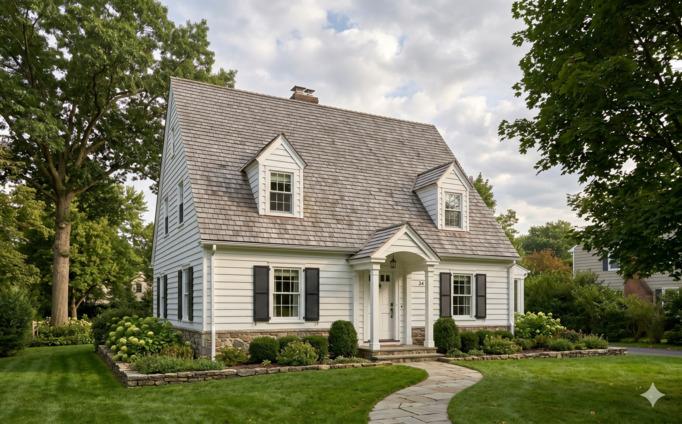
A 12/12 roof pitch rises 12 inches vertically for every 12 inches of horizontal run — exactly 45° from horizontal. The slope as a percentage is 100% (rise equals run). The slope factor is √2, or about 1.414, which means the actual roof surface area is 41.4% larger than the building footprint underneath. It is the threshold pitch between "steep" and "very steep" in conventional residential framing language.
This guide covers the 12/12 numbers, why builders sometimes choose this pitch despite its cost, materials and labour considerations, and how it compares to less-extreme conventional pitches.
12/12 by the numbers
A 12/12 pitch is exactly 45° from horizontal — the only standard pitch where rise equals run. The slope percentage is 100%. The slope factor is √2 ≈ 1.414, the largest factor among the conventional residential pitches before "very steep" begins.
For a 1,500 sq ft footprint, a 12/12 gable has roughly 2,121 sq ft of roof surface — 41% more area than a flat ceiling of the same footprint. That has direct implications for material cost: shingles, sheathing, and underlayment all scale with surface area, so a 12/12 reroof is roughly 35-40% more expensive in materials than a 4/12 reroof on the same building footprint.
Rafter length at 12/12: for every foot of horizontal run, the rafter length itself is 1.414 feet. A 14-foot run produces a 19.8-foot common rafter — substantially longer than the 14.8-foot rafter at 4/12.
| Property | Value | Comparison to 4/12 | Notes |
|---|---|---|---|
| Angle from horizontal | 45.00° | +26.6° vs 18.43° | Exactly 45° — rise equals run |
| Slope percentage | 100% | vs 33% | Three times steeper |
| Slope factor (surface multiplier) | 1.414 (√2) | vs 1.054 | 34% more material than 4/12 |
| Rafter length per ft of run | 1.414 ft | vs 1.054 ft | Common rafter scales by slope factor |
| Surface area for 1,500 sf footprint | ~2,121 sq ft | vs 1,581 sq ft | +540 sq ft of roofing material |
| Walkability | Edge of walkable; harness mandatory | vs comfortably walkable | OSHA requires fall protection above 6/12 |
| Labour premium vs baseline | +25-40% | vs baseline | Productivity drop from harness work |
| Snow load behavior | Snow slides off readily | vs snow accumulates | Reduces structural snow load |
| Solar panel suitability | Suboptimal angle (too steep) | Near-optimal angle | 5-15% lower energy production than 6/12 |
When 12/12 makes sense
Three architectural traditions account for most 12/12 roofs in U.S. residential construction. First: traditional Cape Cod, Tudor, and Gothic Revival styles where the steep roof is a defining stylistic element. The roof itself becomes the dominant visible mass of the house, with second-story rooms tucked under the slope.
Second: full second-story finished-attic designs. At 12/12, the full attic floor area is usable as headroom — versus roughly half-usable at 6/12 and 60-70% at 8/12. For homes that incorporate the attic as living space rather than storage, 12/12 maximizes the usable floor area.
Third: heavy-snow regions where steep pitches shed snow load. Above roughly 6/12, snow tends to slide rather than accumulate. At 12/12, snow load on the structure is minimal because most snow does not stay on the roof. The downside is sliding-snow safety — required snow guards, predictable snow-shed zones at eaves, and potential ice-dam concerns at the lowest sections.
What 12/12 costs
A 12/12 roof costs more than its 4/12 or 6/12 equivalents in three ways. First, surface area: 41% more than the footprint, versus 5% at 4/12 or 12% at 6/12. Material costs (shingles, sheathing, underlayment) scale linearly with surface area.
Second, labour. Above 8/12, OSHA requires fall-arrest equipment for residential roofing work, which slows movement and material handling. At 12/12, harness work is mandatory and labour productivity drops 25-40%. Many contractors charge a 25-50% premium on labour rates above 12/12.
Third, equipment. Steep-pitch work above 12/12 sometimes requires scaffolding rental or specialized roof brackets, adding $500-2,000 in fixed equipment costs to a project.
For a typical 2,000 sq ft single-story house at 12/12 vs 4/12 with architectural asphalt shingles: 4/12 runs $11,000-18,000 installed; 12/12 runs $14,000-24,000 — a 25-35% premium for the steeper pitch.
Materials at 12/12
At 12/12, every standard roofing material is well within its pitch range. The constraints become less about material compatibility and more about install difficulty and detailing.
Asphalt shingles install with standard single-layer underlayment. The steep pitch sheds water aggressively, so underlayment durability is more about temperature resistance (steep dark roofs run hotter) than water exposure.
Standing-seam metal works well at 12/12 — many architectural metal applications target this pitch specifically. The clean steep profile is part of the visual appeal.
Tile and slate are well-suited to 12/12. Historically, slate was specified specifically for steep European roof traditions, and the 12/12 pitch is in the heart of slate's ideal range. Tile manufacturers usually rate their products well above 12/12.
Wood shake at 12/12 has excellent water shedding but the steep pitch makes installation slower. Many shake roofers add a 25-40% labour premium above 12/12.
Walkability and safety
A 12/12 roof is at the upper boundary of "walkable with caution". Most experienced roofers can navigate a dry 12/12 with non-slip footwear and care, but the work is slow and tiring. OSHA requires fall protection — harness, anchor, and rope — for any residential work above 6/12 (the strict reading) or 8/12 (the practical reading).
Above 12/12, scaffolding or hard-rope access becomes the typical approach. The labour productivity penalty is significant, which is why labour rates step up so much.
For homeowners: never attempt to walk on a 12/12 roof. Even simple tasks like inspecting after a storm or clearing debris should be left to professionals with proper fall arrest. The combined factors of slope, height, and shingle slipperiness in any moisture conditions create a high-risk environment.
How 12/12 compares to neighbours
Compared to 8/12 (a steep but not extreme pitch), 12/12 has 17% more surface area, considerably more attic volume, and substantially higher labour cost. The 8/12 to 12/12 step is where the labour premium accelerates.
Compared to 18/12 (a very-steep pitch), 12/12 is meaningfully more affordable to build because scaffolding requirements are lighter and standard roofing crews can still work with harness-and-anchor rather than specialized rope-access trades. 18/12 also pushes into "specialty trades only" territory in many markets.
For most homeowners considering 12/12 versus alternatives: pick 12/12 if the architectural style requires it (Tudor, Gothic Revival, traditional Cape Cod) or if you are committed to a full-floor finished attic. Otherwise, 6/12 to 8/12 produces similar visual impact at meaningfully lower cost.
Need to run the numbers?Use the free roof pitch calculator on the home page to convert pitch to angle, calculate rafter length, or estimate roof area in any unit.