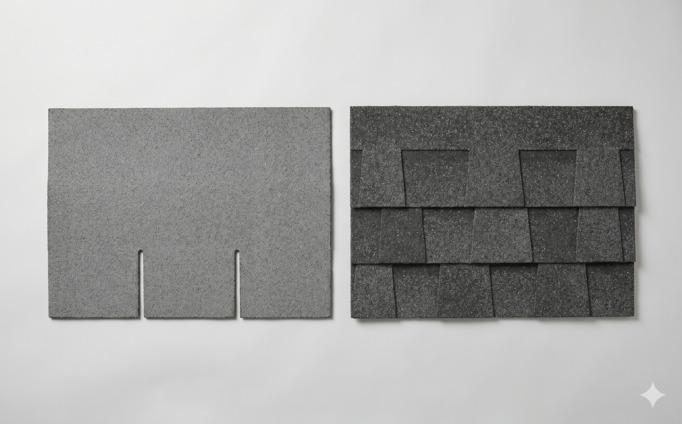
Asphalt shingle prices in 2026 split cleanly into three tiers. Three-tab shingles run $30 to $45 per square (a roofing "square" is 100 sq ft) for materials alone. Architectural laminated shingles run $45 to $75 per square. Designer and impact-rated premium shingles range from $75 to $200 per square. Installed costs typically double those figures because labour, underlayment, drip edge, ridge cap, and disposal add roughly equal weight to materials.
Roof shingles prices vary mostly by tier rather than by brand within a tier — the major brands (GAF, Owens Corning, CertainTeed, IKO, Tamko, Atlas) sit within $5-10 per square of each other in the same product class. Shingle cost moves with crude-oil feedstock prices, regional labour rates, and supply-chain conditions; the 2026 ranges in this guide are about 20-30% above 2019 baselines and have been roughly flat since 2024.
For a typical 2,000 sq ft house, that translates to material costs of $1,800 to $4,500 for the cheapest tier, $2,700 to $4,500 for the most common architectural tier, and $4,500 to $12,000 for premium products. Installed total project costs typically run $7,000 to $20,000 depending on tier, complexity, and region.
This guide covers asphalt shingle prices in every format your contractor or supplier might quote in — by the square, by the bundle, by the square foot, and by complete installed roof. It also walks through the difference between 30-year and lifetime warranty products, what a roof shingle replacement actually costs end-to-end, and where homeowners commonly overpay or underspec their order.
Asphalt shingles cost per square foot
Most contractors and suppliers price asphalt shingles by the square (100 sq ft) — but homeowners often think in square feet, so the per-sq-ft conversion is worth knowing. Asphalt shingles cost per square foot in 2026 ranges from $0.30-0.45 per sq ft for three-tab materials, $0.45-0.75 per sq ft for architectural materials, and $0.75-2.00 per sq ft for designer or impact-rated premium materials. These are material-only figures — installed cost roughly doubles these numbers across all tiers. The same numbers expressed as asphalt shingles cost per sq ft for short — same unit, different abbreviation.
Installed shingles cost per square foot in 2026 falls into three bands. Three-tab installed runs $4-6.50 per sq ft. Architectural installed runs $5.50-9 per sq ft for the most common scenario. Premium materials installed run $8-14 per sq ft on standard residential roofs. Shingles cost per sq ft varies materially by region — coastal cities run 25-40% above national average, the Midwest and South run 15-25% below. Shingles price per square foot in transactional quotes from your local contractor will sit somewhere in that band.
How much do shingles cost per square foot in everyday terms: for a typical 2,000 sq ft footprint house with a 6/12 pitch, the actual roof surface is about 2,236 sq ft (footprint × slope factor 1.118). At $7 per sq ft installed for architectural — the middle of the typical range — that comes to $15,650 for the complete installed project. For just the shingle materials at $0.55 per sq ft, materials alone are about $1,230. The gap between materials and installed is filled by labour, underlayment, flashing, ridge cap, ridge venting, tear-off, disposal, and permits — all the line items a defensible quote should itemize.
The three asphalt shingle tiers
Three-tab shingles are the cheapest mainstream roofing product. They are flat, single-layer shingles cut into three uniform tabs that create the classic flat-pattern roof appearance. They weigh 200-240 lbs per square (compared to 300-400 lbs for architectural), have shorter manufacturer warranties (20-25 years), and shorter real-world service life (typically 15-20 years before they need replacement). At $30-45 per square, three-tabs are the economical choice for rentals, low-end resale homes, and short-term ownership scenarios. They are losing market share rapidly because architectural shingles are not much more expensive but last meaningfully longer.
Architectural shingles (also called laminated, dimensional, or composite shingles) are the modern default for U.S. residential roofs and represent roughly 75% of new roof installations. They consist of two laminated layers that create a thicker, more dimensional appearance with shadow lines that mimic wood shake. They weigh 300-400 lbs per square, carry 30-50 year warranties (often "lifetime"), and last 25-30 years in service. At $45-75 per square, architectural is the clear value choice for most homeowners.
Designer and premium shingles are the top tier and include several distinct categories: impact-rated (Class 3 or Class 4) shingles for hail-prone regions, heavyweight luxury laminates that mimic slate or wood, solar-reflective "cool roof" shingles, and algae-resistant formulations. They run $75-200 per square. The premium is worth paying in specific situations — hail country, specific HOA aesthetic requirements, or coastal regions where wind ratings matter — but it is rarely worth paying just for marginal life extension.
| Tier | Price / square (materials) | Weight / square | Service life | Best for |
|---|---|---|---|---|
| Three-tab | $30 - $45 | 200 - 240 lbs | 15 - 20 years | Rentals, flips, short-hold; losing market share |
| Architectural (laminated) | $45 - $75 | 300 - 400 lbs | 25 - 30 years | Default for most owner-occupied homes — ~75% of new installs |
| Designer / impact-rated premium | $75 - $200 | 350 - 500 lbs | 30 - 40 years | Hail country (Class 4), HOA aesthetics, coastal wind zones |
30-year, 50-year, and lifetime shingles — what you pay for
Asphalt shingle warranty terms (30-year, 50-year, "lifetime") are mostly marketing tiers tied to product weight and laminate construction rather than guarantees of how long the roof will actually last. Real-world service life is determined by climate, ventilation, installation quality, and roof pitch — not by which warranty number is printed on the bundle.
30 year shingles cost per square in 2026 typically runs $40-55 for materials alone — these are entry-level architectural shingles or higher-end three-tabs. Examples include GAF Royal Sovereign (3-tab, 25-year) at $35-45 per square and various basic architectural lines at $45-55. The "30-year" designation usually means the manufacturer rates the product for 30-year wind, granule loss, and material defect coverage, but the prorated terms after the first 5-10 years often reduce the practical warranty value substantially.
50-year and "lifetime" shingles run $55-90 per square for materials. The construction is typically heavier laminate (300-400 lbs per square versus 200-240 for 30-year products), which translates to better wind resistance, more dimensional shadow lines, and a service life closer to 25-30 years in practice. The upgrade from 30-year to 50-year tier on a typical 2,000 sq ft roof costs about $300-700 in materials — small money for the lifespan extension, which is why architectural tier dominates new installs.
The honest summary: pay for 50-year/lifetime tier if you plan to stay in the home long-term and care about the dimensional look. Stay with 30-year if you are flipping or renting. Skip "lifetime" warranty premium claims when comparing similar weight products from the same manufacturer — the difference between a 50-year warranty and "lifetime" is largely paperwork.
Major brands and what they cost
GAF, Owens Corning, CertainTeed, Tamko, IKO, and Atlas are the major U.S. shingle manufacturers. Pricing across brands within the same tier is similar — within $5-10 per square. Differences come from specific product lines, regional availability, and contractor relationships rather than fundamental brand premiums.
GAF Timberline HDZ is one of the most-installed architectural shingles in the U.S., priced at $50-65 per square. Owens Corning Duration runs $55-70 per square. CertainTeed Landmark runs $50-65 per square. These three are the workhorses of the architectural category and any of them is a defensible choice. The differentiator at this price point is contractor familiarity — your roofer probably installs one of them more often than the others, and that experience produces a better roof than an unfamiliar premium product would.
In the premium tier, GAF Timberline AS II (impact rated) runs $90-130 per square. CertainTeed Presidential runs $100-150 per square. Owens Corning Berkshire runs $130-200 per square. Each has specific aesthetic and performance characteristics — Berkshire is the most slate-like in appearance; Presidential is heavyweight laminate for visual depth; Timberline AS II is straight-ahead Class 4 impact protection.
| Brand / product | Tier | Price / square | Notable features |
|---|---|---|---|
| GAF Royal Sovereign | Three-tab | $35 - $45 | 25-year warranty; entry-level workhorse |
| Owens Corning Supreme | Three-tab | $30 - $42 | Standard 3-tab; good wind rating |
| CertainTeed XT 25 | Three-tab | $32 - $44 | 25-year warranty; basic |
| GAF Timberline HDZ | Architectural | $50 - $65 | Most-installed architectural in the U.S.; LayerLock pattern |
| Owens Corning Duration | Architectural | $55 - $70 | StreakGuard algae resistance; SureNail strip |
| CertainTeed Landmark | Architectural | $50 - $65 | StreakFighter algae resistance; broad colour palette |
| Tamko Heritage | Architectural | $48 - $62 | Independent brand; competitive value |
| IKO Cambridge | Architectural | $48 - $60 | Canadian-built; cold-climate strength |
| GAF Timberline AS II | Premium (Class 4) | $90 - $130 | Class 4 impact rating; insurance-discount eligible |
| CertainTeed Presidential | Premium designer | $100 - $150 | Heavyweight laminate for slate-like depth |
| Owens Corning Berkshire | Premium designer | $130 - $200 | Most slate-like profile; premium aesthetics |
Material vs. installed cost — what makes up the difference
Materials are roughly half the installed cost on a typical asphalt roof. The other half is labour, underlayment, drip edge, ridge cap shingles, ice-and-water shield, ventilation, fasteners, dump fees, and overhead. A reasonable rule of thumb: budget 2× to 2.5× material cost for a complete installed roof, with the higher end applying to complex roofs (multiple hips, valleys, dormers).
Labour alone runs $1.50 to $4.00 per square foot of roof surface area, depending on region and pitch. Steeper roofs cost more — anything above 8/12 adds 20-50% to labour because crews work in harnesses and material handling slows down. Two-story houses cost more than ranches because access is harder.
Underlayment has gotten more expensive but also more capable. Synthetic underlayment runs $50-100 per square (for the underlayment itself); ice-and-water shield in valleys and at eaves runs $100-150 per square for the shielded area. Both are worth the cost on any modern roof — felt paper underlayment is obsolete and a false economy.
Roof shingle replacement cost — full project pricing
Roof shingle replacement on a typical U.S. residential home is the most common large home-improvement project after kitchen and bath remodels. The full-project cost — tear-off, materials, labour, and disposal — varies widely by tier and region.
How much to replace roof shingles on a typical 2,000 sq ft home in 2026: with three-tab asphalt, $7,000-13,000; with architectural shingles, $11,000-18,000; with impact-rated premium, $14,000-25,000. New shingle roof price for the same house with standing-seam metal (the next tier up if you are pricing alternatives) runs $20,000-35,000 — useful as a comparison point when evaluating asphalt quotes. How much do roof shingles cost as part of a full reroof scales linearly with house size: a 1,200 sq ft footprint runs roughly 60% of these numbers; a 3,000 sq ft footprint runs roughly 50% more.
How much is a new shingle roof in different scenarios. Simple ranch with 4/12 pitch and minimal complexity: bottom of the typical band ($11,000-13,000 architectural). Two-storey colonial with 6/12 pitch and some dormers: middle of the band ($14,000-17,000). Steep Cape Cod or Victorian with 10/12+ pitch and complex valleys: top of the band or above ($17,000-22,000+). The pitch and complexity premiums are real and roofers will quote them separately when asked. How much does a new shingle roof cost on a complex high-end property in a coastal market: $20,000-30,000+ for architectural-tier products is realistic.
How much do new shingles cost when paired with structural work? If your reroof reveals damaged sheathing or rafters, expect $300-800 per sheet of decking replaced and $200-400 per linear foot of structural framing repair. These are line items contractors typically quote as allowances ("3 sheets included in base, $400 per additional sheet") rather than fixed totals — the actual count is unknown until tear-off.
Bundle math: how shingles are sold
Asphalt shingles are sold by the bundle, but the math is by the square. Three bundles of architectural shingles cover 100 sq ft (one square). A bundle of architectural shingles weighs 65-80 lbs and is the maximum a single roofer can comfortably carry up a ladder. A square of architectural shingles weighs 195-240 lbs.
For pricing, $60 per square translates to $20 per bundle. For ordering, take your roof square footage, divide by 100, multiply by 3 for bundles, and add 10-15% waste. A 1,500 sq ft roof: 1,500 ÷ 100 × 3 = 45 bundles base, plus 5-7 waste bundles, so order 50-52 bundles. Most suppliers will accept returns of unopened bundles, so erring slightly high is safer than running short.
For three-tab, the math is the same — three bundles per square. Some heavy-duty designer shingles are sold at 4 bundles per square because each shingle is significantly heavier. Always confirm bundles-per-square with your supplier before ordering.
Why prices have moved
Asphalt shingle prices rose roughly 30-50% between 2020 and 2024 due to a combination of factors: asphalt feedstock inflation tied to crude oil prices, fiberglass mat shortages, a major manufacturer plant fire that constrained supply, and post-pandemic labour market shifts. Prices stabilized in 2024-2025 and have been roughly flat through 2026.
The supply chain is more resilient now than it was during peak shortage years, but pricing remains 20-30% above 2019 baselines. Multi-year warranty terms, premium product margins, and contractor markups have all adjusted upward to reflect the new normal. Expecting 2019 pricing in 2026 quotes is unrealistic.
Regional price variation is real and significant. Coastal cities run 25-40% above national averages. The Midwest and South run 15-25% below. Hawaii and Alaska are outliers requiring shipping premiums of 50-100% on materials.
What you should actually buy
For most homeowners in most situations, mid-grade architectural shingles from a major manufacturer are the right choice. The incremental cost over three-tabs is small (often $1,000-2,000 on a typical roof) and the lifespan extension is substantial (10+ additional years). The savings on the next reroof typically pay for the architectural upgrade twice over.
Pay the premium for impact-rated (Class 4) shingles only if you are in a region where hail damage is realistic. Many home insurance carriers offer 5-15% premium discounts for Class 4 roofs, which can recoup the upgrade cost in 7-10 years on a typical policy. Hail-prone states include Texas, Oklahoma, Kansas, Nebraska, Colorado, and parts of the upper Midwest.
Skip the premium for designer aesthetic shingles unless your HOA requires them or you are committed to staying in the home long-term and care strongly about appearance. Most buyers cannot tell the difference between a $60-per-square architectural and a $130-per-square designer shingle from the curb.
Three-tab is rarely the right choice on a primary residence in 2026. The 5-10 year lifespan deficit costs more in premature reroof than the upgrade saves up front. Three-tab is still defensible on rental properties, sheds, garages, and short-hold flips.
How we sourced these numbers
The cost ranges in this guide are 2026 U.S. national averages compiled from four sources, weighted to reflect actual contractor and supplier pricing rather than list prices. RSMeans construction cost data provides the labour-hour and material baselines used by professional estimators, indexed to 2026 with regional multipliers. Manufacturer technical bulletins and published distributor pricing from GAF, Owens Corning, CertainTeed, IKO, Tamko, and Atlas confirm material-only ranges by product tier and warranty class. NAHB regional cost surveys ground-truth the labour rates for residential reroofs across major U.S. metros. Direct quotes obtained from contractors in different markets for representative projects (typical 2,000 sq ft architectural-shingle replacement) confirm the live ranges and surface where published averages diverge from current market reality.
Where sources disagree, we publish the wider range and flag the disagreement rather than picking a single number. Shingle pricing moves with crude-oil feedstock costs and supply-chain conditions; the ranges on this page are reviewed quarterly and updated whenever published construction-cost indexes shift more than 5% in any tier. For our full sourcing standard and review cadence, see the methodology page.
For project tools that pair with shingle pricing, this site has dedicated calculators. The roofing calculator handles area calculations. The roof replacement cost reference covers full-replacement pricing combining materials and labour.
For repair-vs-replace decisions and related cost references, see the surrounding workflow. The cost of roof repair page covers minor repair budgets vs. full replacement. The roof sheathing replacement cost reference covers partial-deck-replacement budgeting.
For broader material context and project planning, several references cover the workflow around shingle selection. The roofing materials prices guide covers all material types side-by-side. The roof quote guide covers what a quality contractor bid should include. The roofing square equals 100 square feet reference explains the unit used throughout shingle pricing.
For DIY-leaning homeowners, the diy roof replacement cost reference covers what self-management saves and what it costs in time when shingles are replaced as part of a DIY project.
Need to run the numbers?Use the free roof pitch calculator on the home page to convert pitch to angle, calculate rafter length, or estimate roof area in any unit.